
Ensuring Safety Compliance for Insulated Drinkware in US/EU Markets
When it comes to insulated drinkware, ensuring compliance with safety standards is paramount, especially for markets in the United States and European Union. Manufacturers and suppliers need to adhere to stringent guidelines to ensure consumer safety and meet regulatory requirements. Below, we outline the key safety standards and tests that insulated drinkware must comply with for these markets.
Safety Standards for US Markets
In the United States, insulated drinkware must adhere to several safety regulations, including but not limited to:
- FDA Food Contact Regulations: Materials used in drinkware must meet FDA requirements for safety when in contact with food and beverages.
- Testing for Bisphenol A (BPA): Products must be BPA-free to ensure they are safe for use, as BPA is linked to various health concerns.
- Lead and Heavy Metal Testing: The presence of lead and other harmful heavy metals must fall below permissible levels as defined by the Consumer Product Safety Improvement Act (CPSIA).
- Prop 65 Compliance (California): Products sold in California must meet additional requirements for toxic substances under Proposition 65.
Safety Standards for EU Markets
The European Union has its own set of stringent safety and compliance requirements for insulated drinkware, such as:
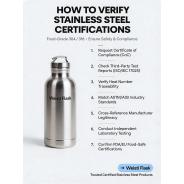
- EU Food Contact Materials Regulation: All materials used in the product must comply with Regulation (EC) No 1935/2004 to ensure they are safe for food contact.
- REACH Compliance: Products must comply with REACH (Registration, Evaluation, Authorisation and Restriction of Chemicals), which restricts the use of certain harmful substances, including BPA.
- LFGB Certification: Products imported into Germany and other EU countries often require LFGB testing to certify they are free from harmful substances.
- Nickel Release Testing: For metallic parts of the drinkware, compliance with EN 1811 is often required to ensure safe levels of nickel release.
Key Tests for Both Markets
Whether for the US or EU, manufacturers should ensure the following tests are conducted on their insulated drinkware:
- Migration Testing: Verifies that chemicals from the product do not leach into beverages during use.
- Thermal Testing: Ensures the product can safely retain temperature without degrading or posing risks.
- Durability Testing: Confirms the product withstands regular use without releasing harmful elements.
Partnering with Reliable Suppliers
To effectively meet these safety standards, it is vital to collaborate with reliable suppliers who understand and comply with regulatory requirements. For example, companies like Weisti Flask specialize in producing high-quality, compliant insulated drinkware, catering to both the US and EU markets.
Conclusion
By focusing on compliance with safety standards and conducting rigorous testing, businesses can ensure their insulated drinkware products are safe, reliable, and market-ready. Meeting these requirements is not only a regulatory necessity but also vital for building consumer trust and brand reputation. For more on compliant and quality drinkware, visit Weisti Flask.


 English
 German
 French
 Russian
 Spanish
 Japanese
 Korean
 Portuguese
 Ukrainian
 Arabic
 Italian


